Best No-Pull Harness for Large Dogs: 8 Top Picks for 2025
If you’ve got a Labrador who thinks he’s a sled dog or a German Shepherd who’s convinced squirrels are the most important thing in the universe, you know the struggle. Walking a large dog who pulls isn’t just frustrating—it’s exhausting, potentially dangerous, and honestly takes all the joy out of what should be quality bonding time.
The right no-pull harness can be a genuine game-changer. Not a magic fix (sorry, training still matters), but a tool that gives you actual control while keeping your dog comfortable and safe. After researching dozens of options and analyzing what actually works for large breeds, we’ve narrowed it down to eight harnesses that deliver on their promises.
Let’s find the one that’ll work for you and your big pup.
Quick Comparison Table
| Harness | Best For | Price Range | Key Feature |
|---|---|---|---|
| Ruffwear Front Range | All-around daily use | $50-70 | Exceptional durability |
| PetSafe Easy Walk | Budget-friendly training | $20-30 | Simple, effective design |
| Blue-9 Balance Harness | Customizable fit | $50-60 | Six adjustment points |
| Kurgo Tru-Fit Enhanced | Car safety + walking | $30-40 | Crash-tested |
| Rabbitgoo Tactical | Heavy-duty control | $25-35 | Reinforced handle |
| Freedom No-Pull | Serious pullers | $35-45 | Dual-clip training system |
| 2 Hounds Design Freedom | Training versatility | $35-50 | Velvet lining option |
| Julius-K9 IDC Powerharness | Professional use | $40-60 | Maximum durability |
What Makes a Good No-Pull Harness for Large Dogs?
Not all harnesses are created equal, especially when you’re dealing with 60-100+ pounds of enthusiastic canine.
Front-Clip Design (The Non-Negotiable)
Here’s the thing about front-clip harnesses: physics is on your side. When your dog pulls forward and the leash is attached at their chest, they get redirected toward you instead of powered forward. It’s not magic—it’s just basic mechanics.
Research published in veterinary journals has shown that front-clip harnesses significantly reduce pulling behavior compared to traditional collars or back-clip harnesses, without increasing intraocular pressure or causing tracheal stress. For large breeds with considerable strength, this matters.
Build Quality for Bigger Bodies
Your 70-pound Golden Retriever can generate serious force when he spots a friendly neighbor. Lightweight harnesses designed for small dogs won’t cut it. Look for:
- Reinforced stitching at stress points
- Metal hardware (aluminum or stainless steel D-rings and buckles)
- Wide straps that distribute pressure across the chest and shoulders
- Durable materials like ripstop nylon or heavy-duty polyester
Adjustability (Because Dogs Come in All Shapes)
Large breeds vary wildly in body type. A Labrador and a Great Dane might both weigh 80 pounds, but they’re shaped completely differently. You need multiple adjustment points to get a secure fit that won’t chafe or restrict movement.
Padding Where It Counts
Large dogs put more pressure on harness contact points. Padding on the chest plate and under the legs prevents rubbing and makes longer walks comfortable. Your dog shouldn’t come home with red marks or worn fur.
The 8 Best No-Pull Harnesses for Large Dogs
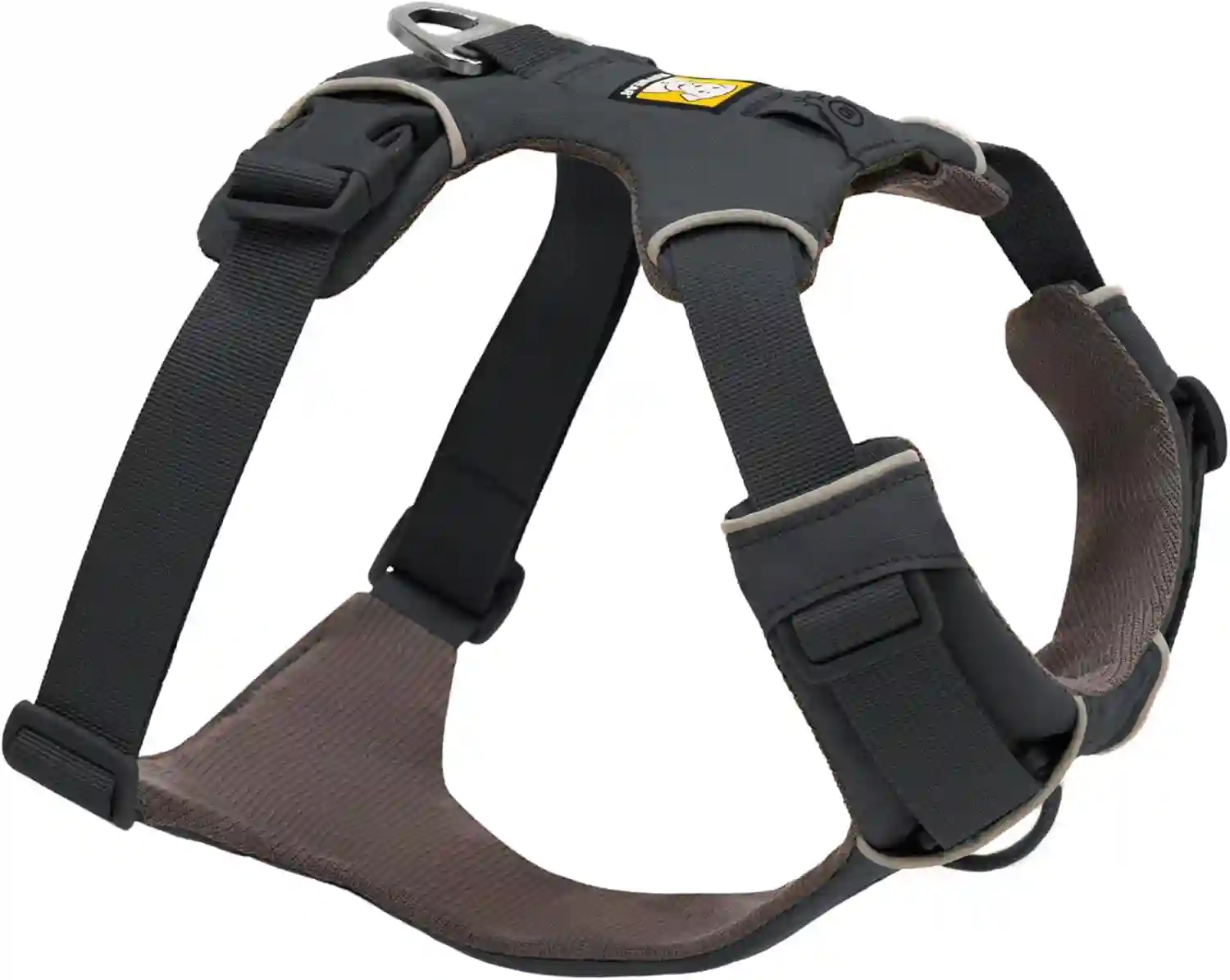
1. Ruffwear Front Range Harness – Best Overall
Size range: Up to 42” chest girth Weight capacity: Suitable for dogs up to 100+ lbs Price: $50-70
The Ruffwear Front Range is what you recommend when someone asks “which harness should I actually buy?” It’s the Goldilocks option—not the cheapest, not the most expensive, but consistently the most reliable for large dogs.
What makes it stand out: The build quality is exceptional. I’ve seen these harnesses last for years of daily use on active dogs. The foam padding on the chest and belly straps prevents chafing, even on longer hikes. Four adjustment points mean you can dial in a custom fit, and the ID pocket on the back is genuinely useful.
The aluminum V-ring on the chest is positioned perfectly for no-pull training. The back D-ring gives you a secondary attachment point once your dog’s pulling improves.
The catch: At $50+, it’s an investment. But for most people with large dogs, this harness will outlast two or three cheaper alternatives.
Best for: Active large dogs, owners who want something that’ll last, dogs with any body type
2. PetSafe Easy Walk Comfort Harness – Best Budget Option
Size range: Available in large (60-90 lbs) and extra-large (90+ lbs) Weight capacity: Tested for dogs up to 180 lbs Price: $20-30
Let’s be honest: not everyone wants to drop $50+ on a harness, especially if you’re still testing whether no-pull equipment works for your dog. The PetSafe Easy Walk is the budget-friendly starting point that actually delivers.
What makes it stand out: The martingale-style loop on the chest discourages pulling by tightening gently when your dog lunges forward (it’s not uncomfortable—just pressure feedback). The nylon webbing is surprisingly durable for the price point, and the quick-snap buckles make it easy to get on and off.
Thousands of dog trainers recommend this harness as a training tool. It’s simple, effective, and gets the job done.
The catch: The straps are thinner than premium options, so they might dig in slightly on extreme pullers. Some dogs also find the belly strap positioning takes getting used to.
Best for: Budget-conscious owners, training puppies before investing in premium gear, dogs who are moderate pullers
3. Blue-9 Balance Harness – Best for Custom Fit
Size range: Multiple sizes up to 45” girth Weight capacity: Large and XL sizes handle 60-100+ lbs Price: $50-60
If your large dog is oddly shaped (deep chest, narrow waist, unusual proportions), the Blue-9 Balance Harness is worth the extra effort to fit properly.
What makes it stand out: Six—yes, six—adjustment points. This all-strap design (no padding or panels) can be dialed in to fit almost any body type. The front and back leash attachments give you training flexibility, and the lightweight design doesn’t add bulk.
Professional dog trainers love this harness because it stays in position and doesn’t restrict shoulder movement, which matters for large athletic dogs.
The catch: The lack of padding means it’s not ideal for dogs with sensitive skin or for long-duration wear. And honestly, it takes some patience to adjust all those straps correctly the first time.
Best for: Dogs with unusual body shapes, professional training scenarios, owners who want ultimate fit customization
4. Kurgo Tru-Fit Enhanced Strength Harness – Best for Car Safety
Size range: Up to 42” chest girth Weight capacity: Crash-tested for dogs up to 75 lbs Price: $30-40
Here’s something most harnesses don’t offer: legitimate car safety testing. The Kurgo Tru-Fit Enhanced Strength harness is crash-tested to manufacturer standards and can double as both a walking harness and a car restraint system.
What makes it stand out: All-steel nested buckles and hardware make this harness bomber. The broad, padded chest plate distributes impact force (and pulling force) evenly. You get both front and back leash attachment points, plus a tether loop for securing to your car’s seatbelt.
For large breeds, having one harness that handles both daily walks and car trips is genuinely practical.
The catch: The crash-test rating is for dogs up to 75 pounds. If you’ve got a 90-pound Rottweiler, this works great as a walking harness but exceeds the rated capacity for car safety.
Best for: Dogs who ride in the car frequently, owners who want multi-purpose gear, German Shepherds, Labs, and Goldens in the 60-75 lb range
5. Rabbitgoo Tactical Dog Harness – Best Heavy-Duty Option
Size range: Large (chest 27-36”) and XL (chest 35-44”) Weight capacity: XL size handles 60-100+ lbs Price: $25-35
If “tactical” sounds like overkill for a dog harness, you haven’t tried to control an 80-pound dog who just spotted a cat across the street. The Rabbitgoo tactical harness is built for serious control without breaking the bank.
What makes it stand out: The reinforced handle on the back is a legit safety feature. You can grab your dog immediately if they lunge or if you need to lift them over an obstacle. The no-pull front clip works well, and the metal buckles and D-rings are military-grade.
The MOLLE webbing on the sides is functional if you want to attach gear pouches (water bottle, poop bags, whatever), though most pet owners won’t use this feature.
The catch: This harness is bulky. It’s not what you want for a dainty-looking dog. But if you’ve got a powerful breed and need maximum control, the bulk is reassuring.
Best for: Powerful breeds (Rottweilers, Mastiffs, Pit Bulls), reactive dogs who need emergency control, owners who want a handle for safety
6. Freedom No-Pull Harness – Best for Serious Pullers
Size range: Large (28-36” girth) to XXL (36-44” girth) Weight capacity: XXL handles 100+ lb dogs Price: $35-45
Some dogs are Olympic-level pullers. If your large breed acts like they’re training for the Iditarod, the Freedom No-Pull harness’s dual-clip system might be the solution.
What makes it stand out: You can attach your leash to both the front chest ring and the back shoulder ring simultaneously using the included dual-connection leash. This distributes control across two points and gives you better steering and stopping power.
The martingale loop on the chest tightens when your dog pulls (similar to the Easy Walk), providing immediate feedback. The velvet-lined straps on some models prevent chafing on sensitive-skinned dogs.
The catch: The dual-clip system takes practice to use effectively. And at $35-45, it’s mid-priced—not budget-friendly, but not premium either.
Best for: Strong pullers who haven’t responded to single-clip harnesses, professional training scenarios, large breeds with smooth coats prone to rubbing
7. 2 Hounds Design Freedom Harness – Best Training Tool
Size range: Multiple sizes up to 41” girth Weight capacity: Large sizes handle 70-120 lbs Price: $35-50
The 2 Hounds Design Freedom Harness is what professional dog trainers reach for when they need to teach loose-leash walking to large, strong dogs.
What makes it stand out: The Swiss-velvet lined chest and shoulder straps are exceptionally comfortable for all-day wear. The martingale front loop provides gentle correction, and the back attachment point lets you transition to less restrictive walking as your dog improves.
The harness stays securely in position without sliding around, which is crucial for consistent training. The hardware is solid, and the range of sizes accommodates most large breeds.
The catch: The velvet lining requires more maintenance—you’ll need to spot-clean it occasionally. And the price is higher than basic options.
Best for: Committed training programs, sensitive-skinned large dogs, owners working with professional trainers
8. Julius-K9 IDC Powerharness – Best for Durability
Size range: Size 2 (28-37” girth) to Size 3 (31.5-42” girth) Weight capacity: Size 3 handles 88-110 lbs Price: $40-60
Julius-K9 harnesses are what you see on police dogs, search-and-rescue teams, and working dogs around the world. They’re built for professional use but work great for pet owners with large, powerful dogs.
What makes it stand out: This harness is virtually indestructible. The chest plate is rigid and padded, the nylon webbing is industrial-strength, and the hardware could probably survive a nuclear blast. The reflective strips make nighttime walks safer.
The top handle is reinforced for lifting and control. And honestly, the customizable velcro patches on the sides are fun—you can label your dog “in training,” “nervous,” or just add their name.
The catch: Julius-K9 uses a chest plate design rather than a Y-shaped front clip. It’s not technically a “no-pull” harness in the traditional sense, but the control and build quality make it work well for large strong dogs once they’ve learned basic leash manners.
Best for: Working breeds, maximum durability needs, dogs who’ve graduated from front-clip training, nighttime walkers
How to Choose the Right No-Pull Harness for Your Large Dog
Measure Your Dog Correctly
Grab a flexible tape measure and measure around the widest part of your dog’s chest, typically right behind the front legs. This is the girth measurement that determines harness size.
Typical large dog measurements:
- Labs, Golden Retrievers: 28-34” girth (70-80 lbs)
- German Shepherds: 30-36” girth (65-90 lbs)
- Rottweilers: 32-40” girth (85-130 lbs)
- Great Danes: 36-44” girth (110-175 lbs)
Don’t guess based on weight alone. A lean 75-pound Shepherd needs a different size than a stocky 75-pound Bulldog.
Consider Your Dog’s Pulling Intensity
Be honest about where your dog falls on the pulling spectrum:
- Mild pullers (occasional tugging): Budget options like the PetSafe Easy Walk work fine
- Moderate pullers (consistent pulling, manageable): Mid-tier options like Ruffwear or Kurgo
- Serious pullers (dragging you down the sidewalk): Heavy-duty options like Freedom No-Pull or Rabbitgoo Tactical
Match the Harness to Your Training Goals
If you’re actively training loose-leash walking, a dedicated no-pull harness with front-clip design is essential. If your dog has already learned not to pull, you might prefer a more comfortable all-day harness with both front and back clip options.
Don’t Forget Comfort for Multi-Hour Use
Planning long hikes or all-day adventures? Padding and breathability matter more than raw strength. The Ruffwear Front Range or 2 Hounds velvet-lined options are designed for extended wear.
How to Use a No-Pull Harness Effectively
A harness alone won’t fix pulling. Think of it as a training tool, not a miracle device.
Proper Fitting Is Non-Negotiable
You should be able to fit two fingers snugly between the harness and your dog’s body at all points. Too loose and it’ll slide around (or your dog might back out of it). Too tight and it’ll chafe or restrict movement.
The front chest strap should sit across the breastbone, not up on the throat. The belly strap should be behind the front legs, not rubbing the armpits.
Pair It with Positive Reinforcement Training
When your dog walks nicely beside you without pulling, reward immediately with treats and praise. The harness helps by redirecting pulling, but your dog needs to learn that walking calmly gets good things.
The front-clip design naturally discourages pulling by creating an uncomfortable redirection when they lunge. But you still need to teach them what you want instead.
Be Patient During the Adjustment Period
Most dogs need a few walks to get used to a new harness, especially if they’ve been wearing collars. Some dogs will try to back out of it initially or walk strangely. Give it three to five walks before deciding whether it’s working.
Gradually Transition to Less Restrictive Gear
Once your dog consistently walks without pulling, you can start using the back clip attachment instead of the front clip. Eventually, some dogs graduate to regular harnesses or even flat collars (though many large dog owners prefer harnesses permanently for safety reasons).
Common Questions About No-Pull Harnesses for Large Dogs
Are no-pull harnesses safe for large dogs?
Yes, when properly fitted. Front-clip harnesses are significantly safer than traditional collars for large dogs because they eliminate pressure on the trachea and throat. Research has shown that collars can increase intraocular pressure and cause breathing issues in dogs who pull, while properly designed harnesses distribute force across the chest and shoulders.
The key is correct fit and quality construction. Cheap harnesses with weak hardware can break under the force of a large dog’s pull, creating a safety hazard.
Will a no-pull harness stop my dog from pulling completely?
Not by itself. A no-pull harness makes pulling physically less rewarding and gives you better control, but training is still required. Most dogs show immediate improvement in pulling behavior when switched to a front-clip harness, but lasting change requires consistent positive reinforcement training.
Think of the harness as making your training 70% easier, not as a replacement for training.
Can I leave a no-pull harness on my dog all day?
Generally not recommended. Harnesses should be removed when your dog is unsupervised to prevent them from getting caught on objects or chewing the straps. They’re designed for controlled walking and training, not all-day wear.
Exception: If you’re actively supervising your dog on a hike or adventure, properly fitted harnesses can be worn for extended periods.
What’s the difference between a no-pull harness and a regular harness?
The attachment point location. Regular harnesses typically have the leash attachment on the back (between the shoulder blades), which gives dogs maximum pulling power—great for sled dogs, not great for leash training.
No-pull harnesses have a front chest attachment that redirects pulling force and naturally discourages lunging. Some harnesses offer both attachment points for training flexibility.
My dog is between sizes. Should I size up or down?
For large dogs, size up. A slightly loose harness can be tightened with adjustment straps, but a too-small harness can’t be made bigger and will restrict movement or cause chafing.
Most quality harnesses have significant adjustability within each size range. Check the manufacturer’s sizing chart and measure carefully.
Do I still need to train my dog if I use a no-pull harness?
Absolutely. A no-pull harness is a training tool, not a training replacement. It makes teaching loose-leash walking easier by reducing your dog’s physical ability to pull and by providing natural feedback when they try.
But your dog still needs to learn what you actually want (walking calmly beside you) through positive reinforcement.
Are front-clip harnesses bad for my dog’s shoulders?
This is a common concern, but research hasn’t found evidence that properly fitted front-clip harnesses cause shoulder problems. The key is fit—the chest strap should rest on the breastbone, not restrict shoulder blade movement.
If your dog’s gait looks strange or restricted, the harness is likely fitted too tightly or the wrong size. Adjust or try a different model.
How long does it take for a no-pull harness to work?
Most large dogs show immediate improvement—less pulling on the very first walk. But complete transformation into a calm, loose-leash walker? That typically takes 2-4 weeks of consistent use combined with positive reinforcement training.
Some dogs catch on within days. Others (especially determined pullers with years of habit) might take a couple of months. Consistency is everything.
Final Thoughts
Walking your large dog shouldn’t feel like an arm workout. The right no-pull harness gives you actual control while keeping your dog comfortable and safe.
For most large dog owners, I’d start with the Ruffwear Front Range. It’s durable enough to last years, comfortable enough for all-day adventures, and effective enough to make real progress on pulling behavior. At $50-70, it’s a genuine investment that pays off.
If budget is tight, the PetSafe Easy Walk at $20-30 is the no-brainer starting point. It works, it’s affordable, and you can always upgrade later if needed.
For serious pullers—those dogs who act like they’re trying to qualify for the World’s Strongest Dog competition—the Freedom No-Pull with its dual-clip system or the Rabbitgoo Tactical with reinforced handle give you the control you need.
Whatever you choose, remember: the harness is a tool. Training is what creates lasting change. Be patient, be consistent, reward the behavior you want, and you’ll get there.
Your shoulders will thank you.
This article is for informational purposes only and is not a substitute for professional dog training advice. Always consult a certified dog trainer for persistent behavioral issues.
Disclaimer: The content on The Bark Life Co is for informational purposes only and should not be considered veterinary or medical advice. Always consult with a qualified veterinarian for health concerns about your pet.